


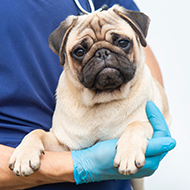
The breeds have evolved with almost identical skulls.
A study by US scientists has revealed that intensive breeding has led to a tendency for “convergence”, a phenomenon where unrelated animals and plants evolve similar traits under similar characteristics.
The team from Cornell and Washington universities used CT scans to measure the skulls of brachycephalic dogs and cats, and found that certain breeds, like pugs and Persian cats, have evolved with almost identical skulls and smushed faces.
Researchers believe that artificial selection, despite being evolutionarily separated for 50 million years, has caused these two species to converge to such an extreme that they are now more similar to each other than other breeds within their own species.
The study, published in Proceedings of the National Academy of Science, is the first to observe the phenomenon in a domesticated species.
Study author Abby Grace Drake, senior lecturer in Cornell’s College of Arts and Sciences, said: “Persian cats and pug and Pekingese dogs all have skull shapes that are very similar to each other, with flat and short faces, and their muzzles and palettes are tilted up in the same way.”
The study highlights the same pattern of convergence multiple times within each species. In dogs, it occurred in bulldog breeds and Pekingese, Shih Tzus. In cats, it notes the same traits in Persian and Burmese breeds.
Dr Drake believes the findings show how artificial selection has driven "remarkable" diversity in cats and dogs, with dog diversity being even more extreme.
“We’re seeing this very large evolutionary variation within a species that’s only been evolving for a relatively very short amount of time,” Drake said. “That’s a remarkable thing to see in evolution, which takes millions of years, but we did it with dogs by pushing them to the extremes,” she said.
Image (C) Shutterstock.


 Defra has published guidance for the vet sector ahead of a proposed UK-EU Sanitary and Phytosanitary agreement.



