


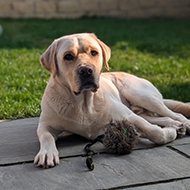
B-tubes avoid multiple operations and enable pets to be treated at home.
Vets have used a novel device called an oesophageal balloon dilation feeding tube, or B-tube, to repair a dog’s damaged throat.
Clinician’s at the University of Edinburgh’s Hospital for Small Animals performed the procedure on two-and-a-half-year old Colt, who could not eat due to a serious constriction in his oesophagus.
Colt had been suffering with gastroenteritis and persistent regurgitation following a general anaesthetic procedure, and had lost 20 per cent of his body weight.
Vets carried out a fluoroscopy, which identified a 9cm narrowing in Colt’s oesophagus and, after consulting with Colt’s owners, it was decided that fitting a B-tube was the best course of action.
Developed in the USA, B-tubes allow the narrow section of a dog’s throat to be gently restored to it’s normal size over time via the repeated inflation of an integrated balloon. Not only does the method eliminate the need for multiple dilations under general anaesthetic, but it also allows for feeding while the stricture is treated.
Colt was discharged from hospital two days after treatment and his B-tube remained in place for six weeks. His owners were trained how to inflate the balloon twice a day, which he tolerated well.
Once the tube was removed, Colt was able to eat a softened GI low-fat food by himself and, within two months, was back to his target weight and eating normally.
Colt’s owners said: “We are forever grateful for all of the wonderful staff and students at the Hospital for Small Animals who treated Colt. He was incredibly unwell when he arrived and the treatment that he received and the aftercare that he still receives is outstanding. Colt is now bouncing back to his normal happy self. We can’t thank you enough for getting our boy back!”
Clinicians hope the availability of new B-tubes can reduce the potential negative effects of multiple operations and enable more pets to be treated at home.
Dr Tyler Morrison ECATv clinical lecturer in small animal internal medicine, Hospital for Small Animals, commented: “Colt is a lovely boy and we are pleased he has made a full recovery whilst avoiding the concerns of multiple anaesthetics.
“His care required close collaboration between our internal medicine team with many of our other specialist teams including anaesthesia and diagnostic imaging, as well as our specialist medicine and nutrition nurses. Importantly, Colt’s care was continued by his dedicated owners at home to achieve this positive outcome. We wish him well for the future.”
Image (C) Royal (Dick) School of Veterinary Studies.


 Defra has published guidance for the vet sector ahead of a proposed UK-EU Sanitary and Phytosanitary agreement.



