


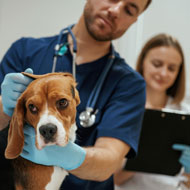
The model analyses CT scans to identify disease.
Researchers have developed an AI model using CT scans that could help vets manage their caseloads.
The study by the Royal (Dick) School of Veterinary Studies, The Roslin Institute, and the University of Edinburgh’s School of Informatics trained around 500 images of dogs’ middle ears — far fewer than the several thousands that would typically be required for AI studies.
Interestingly, the AI model was able to correctly diagnose disease in 85 per cent of the cases, which experts say is a strong outcome for a relatively small sample size — and could be improved if additional images were annotated.
Dr Chris Banks, from the Roslin Institute at the University, commented: “Our study showed that deep learning computer models can be trained to determine whether or not disease is present in a veterinary CT image. Even training our model on a relatively small number of images had encouraging results.
“This outcome is a call to arms to gather resources to enable models of this type, for various veterinary conditions.”
Researchers believe the application of AI underscores its potential to aid in veterinary diagnosis. It is already used in human medicine and could potentially help vets diagnose conditions that are hard to detect by eye, saving both time and money.
Looking ahead, a bank of medical images annotated by vets would be required to train the algorithms, which are readily available at vet schools and hospitals. The AI model could then be applied across a range of conditions.
Dr Tobias Schwarz, from the Royal (Dick) School of Veterinary Studies, said: “This is a great example of how AI can be put to use to help veterinarians, rather than replace them.”
Image (C) Shutterstock.


 Defra has published guidance for the vet sector ahead of a proposed UK-EU Sanitary and Phytosanitary agreement.



