


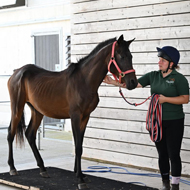
Two-year-old Bourbon weighed around 120kg less than expected.
A South-West animal welfare charity has launched its Christmas appeal after taking in a dangerously underweight horse.
The Mare and Foal Sanctuary says the discovery of Bourbon, in a remote, barren field in Cornwall, highlights the challenge of equine welfare as the cost-of-living crisis continues to bite.
The two-year-old Arab colt had been living on hard, compacted ground, with mud underfoot, with very little to graze on. When he was found by the Sanctuary’s team, he was drastically underweight, with his hips and ribs clearly visible, and a dull, lacklustre coat.
He was assessed by the Beech Trees Veterinary and Welfare Centre in Newton Abbot, who found that he weighed around 120kg less than expected for a horse of his age, breed and type.
Vets quickly devised a structured recovery plan, including a gentle feeding programme with fibre-based feeds, unlimited hay and controlled access to grass to avoid colic. But despite the intensive support, Bourbon still struggled to build weight.
Senior field officer Leah Brock said: “Blood tests showed that his liver wasn’t functioning properly, and we believe it was damaged. We started a supplement regime to help his liver to heal.”
Vets also investigated a subtle head tilt with x-rays and neurological exams, checking his neck mobility, limb placement and tails response to rule out serious nerve problems.
Despite his challenges, Bourbon is said to have an amazing temperament and is thriving on human interaction.
Horse care team member Georgina Ballard said: “He’s very gentle and sweet. You wouldn’t know he hadn’t had much handling. Aside from not picking up his feet or leading initially, he behaves like a well-handled horse, with no fear of humans.”
Bourbon will continue his recovery on one of the Sanctuary’s sites with a herd of young horses.
The Mare and Foal Sanctuary provides confidential, non-judgemental advice to anyone struggling with their equine. This December, as many families continue to juggle the rising cost of living, the charity is appealing for donations to continue their support for Bourbon and other equines facing similar hardships.
For more information and to make a donation, visit mareandfoal.org/bourbon
Image (C) The Mare and Foal Sanctuary.


 Defra has published guidance for the vet sector ahead of a proposed UK-EU Sanitary and Phytosanitary agreement.



