
Your data on MRCVSonline
The nature of the services provided by Vision Media means that we might obtain certain information about you.
Please read our Data Protection and Privacy Policy for details.

In addition, (with your consent) some parts of our website may store a 'cookie' in your browser for the purposes of
functionality or performance monitoring.
Click here to manage your settings.
If you would like to forward this story on to a friend, simply fill in the form below and click send.

Your friend's email:
Your email:
Your name:
 
 
Send Cancel

Charity launches fundraising appeal to help grey seal pups
The Scottish SPCA says well-meaning members of the public can unintentionally cause abandonment by approaching pups. 

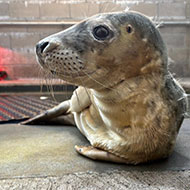
The Scottish SPCA is caring for as many as 50 pups at any one time. 

The Scottish SPCA has launched a fundraising appeal following a steep rise in seal pup admissions to its National Wildlife Rescue Centre in Fishcross, Alloa. 

The centre says the centre is managing its busiest period for grey seal rescue and rehabilitation, with as many as 50 pups in its care at one time. Each one requires round-the-clock attention, veterinary treatment, and medication.

Last May, unseasonably warm weather triggered the start of a busy seal season for the SSPCA. Twenty-five orphaned seal pups arrived at once, with admissions continuing to rise in the weeks that followed.

In response, staff at the centre developed an innovative bottle-feeding technique with a balanced seal specific milk formula. The method has transformed early-stage care for premature and vulnerable pups, providing a positive, low-stress feeding experience. 

It is thought the current peak in admissions is being driven by human interference. The Scottish SPCA says well-meaning members of the public can unintentionally cause abandonment by approaching pups, while disturbing a pregnant seal can also trigger early birth and abandonment. 

One seal who is currently receive treatment is Zelda, who arrived severely underweight and covered in infected wounds, most likely from an attack by a bull seal or an unleashed dog. 

Scotland is home to around 90 per cent of the UK’ seal population. Harbour seals are already vulnerable, with their population on the west coast declining by around 20 per cent in recent years.

Donations from the fund will help the charity to cover the costs of rescuing, treating and rehabilitating seal pups during this exceptionally busy period.

Image (C) Scottish SPCA. 

Become a member or log in to add this story to your CPD history

Equine Disease Surveillance report released for Q4 2025

News Story 1
 The latest Equine Disease Surveillance report has been released, with details on equine disease from Q4 of 2025.

The report, produced by Equine Infectious Disease Surveillance, includes advice on rule changes for equine influenza vaccination.

Statistics and maps detail recent outbreaks of equine herpes virus, equine influenza, equine strangles and equine grass sickness. A series of laboratory reports provides data on virology, bacteriology, parasitology and toxicosis.

This issue also features a case study of orthoflavivus-associated neurological disease in a horse in the UK. 

Click here for more...
News Shorts
NSA webinar explores sheep tailing and castration

The National Sheep Association (NSA) is to host a free webinar on the castration and tail docking of lambs.

The webinar, 'Understanding the tailing and castration consultation: A guide for sheep farmers', will be hosted online on Monday, 2 March 2026 at 7.30pm.

It comes during a government consultation into the methods used for these procedures. Farmers are encouraged to engage before the consultation period closes on Monday, 9 March 2026.

The webinar offers clear and actionable guidance to support farmers to contribute meaningfully to the consultation and prepare for potential changes.

On the panel will be former SVS president Kate Hovers, farmer and vet Ann Van Eetvelt and SRUC professor in Animal Health and Veterinary Sciences Cathy Dwyer. Each panel member will utilise their own specialism and expertise to evaluate risks and outcomes to sheep farming.

Find out more about the webinar on the NSA website.


